
Defense in murder and manslaughter trials
Criminal proceedings for homicide offenses such as murder or manslaughter represent a particularly traumatic life event for both the accused and their families. As a rule, those accused in murder and manslaughter cases are held in pretrial detention, and the defense process and the court proceedings themselves have many unique characteristics, making qualified expertise essential.
Right to remain silent
First and foremost: If you are accused of murder or manslaughter, it is absolutely essential to exercise your right to remain silent. Remaining silent is the best course of action, as any statements or even details you make could be detrimental to you later on – even if your intention is simply to exonerate yourself. This is especially true in cases involving crimes against life and limb. Stay calm and contact a lawyer. – he will discuss the next steps with you and initiate all necessary procedures.
Difference between murder and manslaughter
It is often assumed by laypeople that the difference between murder and manslaughter lies in the fact that murder is an intentional crime and manslaughter a negligent one. This assumption is incorrect, however, as both acts require intent. Manslaughter is the Basic facts, according to which the intentional killing of a person is punishable. Murder is committed when, in addition to the intentional killing, one of the 9 Murder characteristics This is realized. If a person is not intentionally killed, the charge is usually negligent homicide according to § 222 of the German Criminal Code (StGB).
homicide
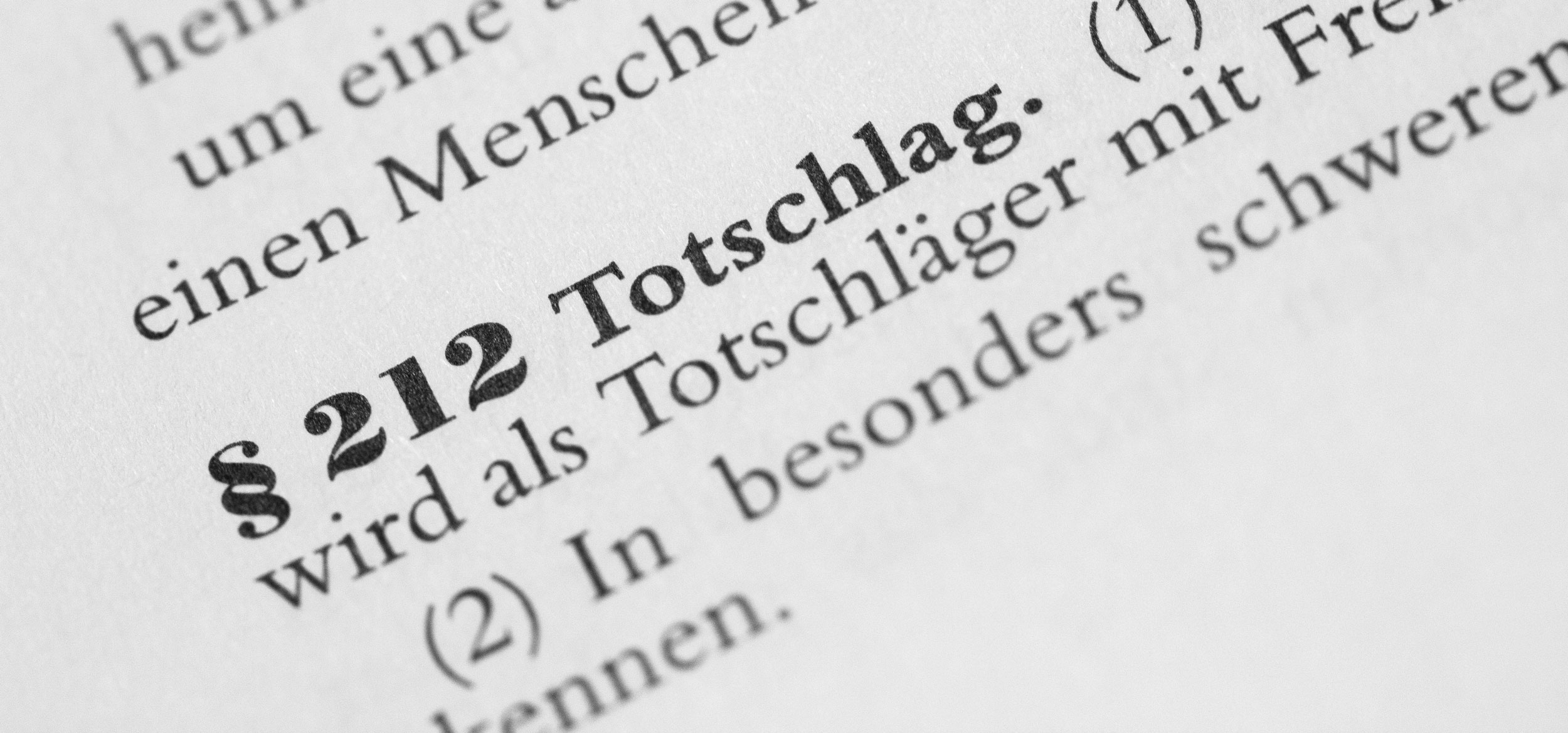
The criminal offense of manslaughter is defined in Section 212 of the German Criminal Code (StGB). The offense is committed when, objectively speaking, a person is killed without any element of murder being present. Subjectively, the offense also requires (at least) that the perpetrator acted intentionally. Various scenarios are conceivable, such as the perpetrator specifically desiring the outcome, i.e., the person's death, being aware of the fatal consequences, or accepting the death as a likely consequence. In practice, the presence of an element of murder is often disputed and difficult to prove, resulting in considerable defense options.
Manslaughter is – as a rule – punished less severely than murder. Manslaughter can be punished with a Prison sentence of between 5 and 15 years They will be punished. However, according to Section 212 Paragraph 2 of the German Criminal Code (StGB), a life sentence can also be imposed if it is a particularly serious case of manslaughter. In less serious cases, the prison sentence according to Section 213 of the German Criminal Code (StGB) is between one and ten years.
murder
Murder is regulated in § 211 of the German Criminal Code. Because murder is generally subject to a criminal prosecution. life imprisonment In such cases, proving the absence of a characteristic element of murder is of utmost importance in the defense. The elements of murder are then met., Murder is committed when someone is intentionally killed and one or more of the nine characteristics of murder are fulfilled. A distinction is made between perpetrator-related and act-related characteristics of murder.
Perpetrator-related characteristics of murder are the killing
- out of bloodlust,
- to satisfy sexual urges,
- out of greed, i.e., someone who expects an economic advantage from the killing,
- for base motives, i.e., in cases of killing for particularly reprehensible reasons, and
- to enable or
- to cover up another crime.
Federal Court of Justice (BGH), decision of 26.08.2025 (case no. 5 StR 368/25) on the assumption of base motives in a so-called „femicide“:
In its decision of August 26, 2025, the Federal Court of Justice (BGH) ruled that the fact that the motive for the crime was based on a separation initiated by the victim does not preclude the finding of base motives. The BGH thus rejected the appeal of a defendant who had been sentenced to life imprisonment for murder motivated by base motives. He had killed his ex-wife with stab wounds and kicks in a fit of rage over her separation from him, the granting of custody of their four children, and the allocation of the marital home. In its ruling, the BGH clarified that the concept of humanity enshrined in the Basic Law and the values of German law preclude attributing any significance to the legitimate exercise of the right to self-determination in the socio-ethical evaluation of the motive for the killing.
Federal Court of Justice (BGH), decision of 12.08.2025 (case no. 5 StR 688/24) on the assumption of murder in the case of the victim's escape and subsequent being run over by a third party:
According to the German Federal Court of Justice (BGH) ruling of August 12, 2025, an act constitutes murder even if the victim's death only occurs because the victim flees from the perpetrator and dies in an accident. In the underlying case, the defendant attacked the victim with multiple stab wounds in a car, intending to kill him. The victim, however, managed to escape onto the road, where he was then run over by a truck and killed. The BGH considered this event to be an act committed by the defendant, as the new chain of events directly followed and built upon the defendant's unlawful conduct, which was driven by the intent to kill. In the case at hand, this was merely an insignificant deviation from the established causal sequence, since the intent to kill was also encompassed by the defendant's intent.
Murder characteristics relating to the act itself, so-called act-related characteristics of murder are
- the treachery, i.e., when the victim's unsuspecting and defenseless state is exploited,
- the particular cruelty and
- The use of means that endanger the public, i.e., when the means used in the crime endanger several people in an uncontrolled manner.
Unlike other crimes, the court has no discretion in determining the sentence for murder, so the prison sentence is always life imprisonment. This also generally means that the perpetrator will spend the rest of their life in prison – unless they are convicted. is released on probation. However, such early release can only be requested after a certain period of imprisonment has been served; in the case of life imprisonment, according to Section 57a Paragraph 1 No. 1 of the German Criminal Code (StGB), this is at the earliest after 15 years. Whether the remainder of the sentence is suspended on probation then depends on the circumstances of the individual case, in particular the offense itself, the offender's personality, and their future prospects. If, on the other hand, the offender has been found to have committed a particularly heinous crime, early release after 15 years is not yet possible.
For a attempted murder There is generally no specific penalty. However, Section 23 Paragraph 2 of the German Criminal Code (StGB) stipulates that an attempt pursuant to Section 49 Paragraph 1 of the German Criminal Code (StGB) is punishable less severely. can as a completed act. However, attempted murder is often accompanied by another offense – in particular, a conviction for dangerous bodily harm under Section 224 of the German Criminal Code (StGB) may also be considered.
Section 78, paragraph 2 of the German Criminal Code (StGB) stipulates that a Murder never expires, which is why such an act can still be prosecuted even after many decades, insofar as new investigative approaches emerge or new evidence appears.
Withdrawal from murder or manslaughter
Murder or manslaughter can also be attempted. For this to be the case, the perpetrator must intentionally and with the intent to commit murder immediately, without the intended result, i.e., the death of another person, occurring. resignation without penalty According to § 24 of the German Criminal Code (StGB), this is only conceivable if the further execution of the crime is voluntarily abandoned or the completion (i.e., the killing) is prevented.
Pre-trial detention
In cases involving allegations of homicide, pre-trial detention is a regular threat. Both the charge of murder (§ 211 of the German Criminal Code) and that of manslaughter (§ 212 of the German Criminal Code) constitute serious crimes, so the suspicion of such an offense triggers the recourse to pre-trial detention under § 112 para. 3 of the German Code of Criminal Procedure. own grounds for detention Justified. Therefore, in the case of such an accusation, it is not necessary – for example, in addition – for one of the classic grounds for detention, such as risk of flight or risk of obstruction of justice.
Should Pre-trial detention If a warrant has been issued, the accused must be brought before a judge before detention. At that point, a public defender will be appointed to each accused person if they do not already have another lawyer. Even after a public defender has been appointed, another lawyer can still be consulted and retained. Due to the seriousness of the charges and the potential sentence, it is generally advisable to retain a criminal defense attorney with experience and qualifications, particularly in homicide cases.
Criminal defense
If you are facing charges of murder or manslaughter, this is an extremely stressful situation not only for you but also for your family. We are happy to assist you with your defense. Together with you, we will develop the right defense strategy for your case and explore all possible avenues. As experienced criminal defense lawyers in Hamburg and the surrounding area, the lawyers in our office offer you the necessary experience!
FAQ:
What is the difference between murder and manslaughter?
Both are intentional killings of a human being, with manslaughter being the basic offense and murder requiring an additional characteristic of murder (e.g., treachery, greed).
What is the penalty for murder and manslaughter?
Murder always carries a life sentence. Manslaughter is punishable by imprisonment for between 5 and 15 years, with longer sentences possible in particularly serious cases and shorter in less serious cases.
Can murder have a statute of limitations?
No, murder never expires. Manslaughter expires after 20 years.
How is murder legally defined?
According to § 211 of the German Criminal Code (StGB), a murderer is anyone who kills a person out of bloodlust, to satisfy sexual urges, out of greed or other base motives, insidiously or cruelly or with means dangerous to the public or to enable or conceal another crime.
What does "attempted murder" mean?
Attempted murder occurs when someone begins to kill another person in a manner that fulfills the criteria for murder, but the act does not result in death. Attempted murder is also a crime, but the punishment is usually less severe than for completed murder. Attempted murder may be exempt from punishment if the perpetrator voluntarily abandons the act or prevents its completion.
What are the most common motives for murder?
In our experience as criminal defense lawyers, the reasons for murder often stem from escalating conflicts in relationships or within families, but also include financial interests, a need for power, or involvement in organized crime. Of course, we cannot provide empirical data on this.
Can someone be convicted if there is no body?
Yes, that's possible. For that to happen, there must be sufficient evidence of a murder, without any traces on the body having been examined.
How is a murder solved?
The most common investigative measures in homicide cases are crime scene and evidence collection, witness interviews, forensic reports and the evaluation of digital traces (e.g. mobile phone or computer data).
Can internet searches be used as evidence?
Yes, in principle, digital traces can be used as circumstantial evidence. In most cases, they are not sufficient as proof on their own, but they can support other evidence.
How common are homicides in Germany?
Homicides are relatively rare in Germany, and the clearance rate is very high at over 90%. However, for solid empirical findings, other sources should be consulted.